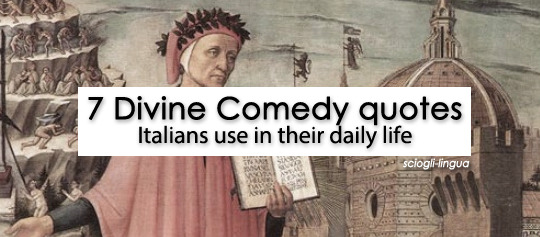
There’s a reason why Dante is known in Italy as the “Supreme Poet”; his immortal verses are ingrained in our collective memory, having been studied by countless generations of students, and often find their way in our everyday speech as well. The following expressions, all taken from his Divine Comedy, will sound at least familiar to most Italians, even though not everyone uses them or knows their original meaning. See if you’ve already heard them!
1. Non ti curar di lor, ma guarda e passa
This is actually a common distortion of the original verse “Non ragioniam di lor, ma guarda e passa” (”Let us not speak of them, but look and pass on”), uttered by Vergil in the third Canto of the Inferno [Hell]. He’s urging Dante not to pay too much attention to the souls they’re passing by, belonging to those who took no sides in life and therefore did nothing to be remembered. It’s commonly used to say that one shouldn’t worry about others spreading slander about them, but just ignore it and go on with their life.
2. Lasciate ogne speranza, voi ch’intrate
Also quoted as “Lasciate ogni speranza, o voi ch’entrate” (”Abandon all hope, ye who enter here”), it’s not really used as a saying, but you’ll have a hard time finding an Italian school without this sign hanging out or inside one or more classrooms. It’s supposed to be a part of the inscription found on top of the gates of Hell, so you can draw your own conclusions.
3. Senza infamia e senza lode
The original quote being “coloro / che visser sanza ‘nfamia e sanza lodo” (”those who lived without infamy and without praise”), this expression once again refers to those who took no sides in life, and is used in the third Canto of the Inferno. If something is “senza infamia e senza lode”, it means that it’s mediocre: not terrible, but not that great either.
4. Galeotto fu…
In the second circle of Hell are those overcome by lust; among them Dante comes across Francesca da Rimini and her lover, Paolo Malatesta. Francesca was in an arranged marriage with Giovanni Malatesta (also known as Gianciotto), but quickly fell in love with his younger brother, and began to carry on an adulterous affair with him, until the two were surprised and killed by her husband. Through the voice of Francesca, Dante describes how the pair finally surrendered to love while reading the old French romance Lancelot du Lac, and especially the description of the adultery between Guinevere and Lancelot. “Galeotto fu ‘l libro e chi lo scrisse” (”A Gallehaut was the book, and he who wrote it”), says Francesca, meaning that the book served as an intermediary for their love just like the character of Gallehaut did for Lancelot and Guinivere’s. Nowadays, any object or person that ends up favoring a romantic relationship can replace the word “libro” in this construction.
5. Il bel Paese
Italy is commonly (and sometimes ironically) known as “il bel Paese” (”the fair land”), and that’s thanks to Dante and Petrarca’s verses, who respectively wrote “del bel là Paese dove ‘l sì sona” (”Of the fair land there where the ‘Sì’ doth sound”, Inferno, canto XXXIII) and “il bel paese / ch’Appennin parte e ‘l mar circonda e l’Alpe” (”that fair country / the Apennines divide, and Alps and sea surround”).
6. Il gran rifiuto
“Colui / che fece per viltade il gran rifiuto” (”He who / due to cowardice made the great refusal”, Inferno, canto III) is commonly thought to be Pope Celestine V, who was only pope for five months in 1294 before he resigned, enabling Bonifacio VIII to take up the position; Dante was notoriously salty about this, since he wasn’t really on good terms with Boniface (who was responsible for his exile from Florence). As you might imagine, this quote made a huge comeback back in 2013, when pope Benedict XVI also resigned, but it’s often employed in less extraordinary situations, usually for comedic effect.
7. Stai fresco
“Stare fresco” usually means to be in for some trouble, or to delude oneself into thinking that one will escape a negative (and predictable outcome); “Stai fresco!” is roughly equivalent to “Yeah, right!” or “In your dreams!”. The expression apparently refers to a specific place in Dante’s Hell, the frozen lake of Cocytus, “là dove i peccatori stanno freschi” (”there where the sinners are put to stay fresh”).
she should greet jane as if nothing happened and see how jane reacts
she should avoid school the next day. And the next. Every night, she should put on the exact outfit she had on that day, hose herself down until she’s completely drenched and stand in Jane’s yard. When Jane is home alone, she should approach the window, staring at her. Knock on it if you don’t have her attention.
That’ll get her back for killing you and trying to hide the evidence.
not to start drama in the history fandom but some of yall out there have really bad opinions and also no critical thinking skills
also while I’m here: historical figures aren’t your fandom faves. they’re real people who had profound and often terrible effects on other real people. you can’t apply fandom logic to them. you can’t fill in the blanks with no evidence other than you like the idea. you can’t vilify some of them while simultaneously stanning over “”misunderstood babies”” who committed equal atrocities. and perhaps most importantly of all, you can’t treat real history as “canon” and develop AUs where your fave is exactly how you want them to be with none of the nasty bits attached. that’s not how you read history. that’s how you get a painfully obvious bias which makes your conclusions and contributions useless.
it’s ok u can say hamilton
full disclosure i was talking about the soviet union idk what’s going on in the hamilton sphere and i wanna keep it that way


















 Goldnwulf