Today’s installment of why“but it has always been like this!” is a bullshit argument: @nitratediva lays down the law about the role of women in early Hollywood
When Henry VIII’s longed-for son Edward VI died in 1553, there were ten remaining legitimate–excepting the problematic cases of Henry’s daughters–heirs to the English throne that descended from Henry VII and Elizabeth of York. Despite the obsession of both Henry VIII and later Edward with “heirs male,” nine of the ten were women. According to Henry’s will, just five were actually eligible to inherit the throne, and all of these candidates were women.
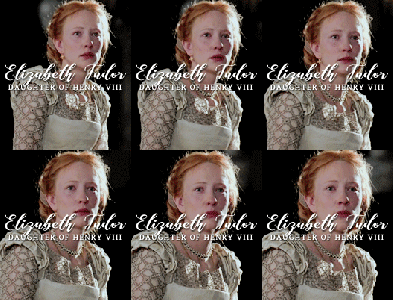
Edward made changes to the succession before his death. His two sisters were both supposedly illegitimate: Mary, daughter of Henry’s first wife Katherine of Aragon, was 37; Elizabeth, the daughter of his second wife Anne Boleyn, was 19, almost 20. Though Henry had reinstated them in the succession before his death, Edward–a devout, almost fanatical Protestant–was reluctant to allow the equally pious but very Catholic Mary to become queen. Elizabeth was a Protestant, but since he was unable to disinherit just one, the young king passed over both of his sisters.
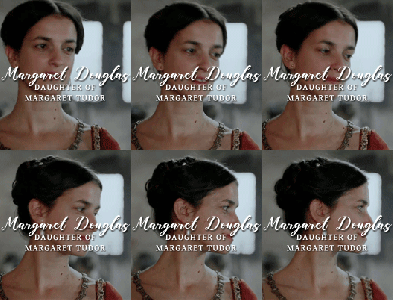
Obeying his father’s wishes to exclude them, Edward also did not consider his any of his three Scottish cousins, Margaret Douglas, her young son Henry (Lord Darnley), or Mary Stuart, the Queen of Scotland. Margaret Douglas was the only surviving child of Margaret Tudor, the elder sister of Henry VIII; like Lady Mary, she was 37. (Her son was theoretically Edward’s only available male heir and also the youngest potential candidate.) Mary of Scots, Margaret Tudor’s granddaughter by her son James, was just ten that summer. While she would never inherit the English throne, Mary’s son with Darnley eventually became the King of England himself as James I.
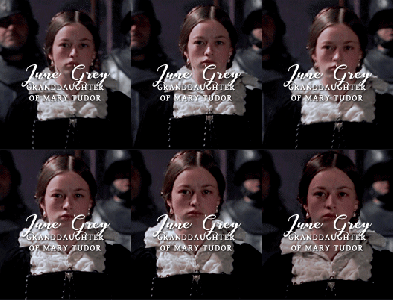
Henry’s younger sister, Mary, also had a surviving daughter, Frances Grey (née Brandon), who was 36. Frances, like Margaret Douglas, was according to the will of Henry VIII barred from the throne, as had been her younger sister Eleanor Brandon, who had since died. However, Frances had three daughters, all of whom Henry–and Edward after him–did consider heirs: Jane, 15; Katherine, 12; and Mary, 8. The late Eleanor also had a thirteen-year-old daughter, Margaret Clifford.
When the king fell ill, the Grey sisters were all hurriedly married or betrothed in hopes that one of them would produce a son. Within months, however, it became obvious that Edward was dying. Either he or his advisors then chose Jane Grey, well-educated and fervently Protestant, as the most suitable heir. Neither Jane nor Edward’s sister Lady Mary, the would-be heir, learned about this sudden change until after Edward died. Yet despite his plans and fears, by mid-July 1553, after Jane spent a brief nine days as the nominal queen, Mary came to London with the support of the people to claim what she saw as her birthright. After her life had been disrupted and dominated by her father’s ever-more desperate desires for a son, his eldest daughter finally became the Queen regnant of England. Though hers was not a successful or popular reign, Henry’s other daughter followed her in 1558.
There is, of course, no small irony in the ascensions of Mary and Elizabeth (nor in the overall lack of boys in the Tudor family tree). After the decades-long obsession of Tudor kings with dynastic stability and legitimate male heirs, Tudor queens ruled England for half a century, and most of that time was peaceful and prosperous. (The historical discourse about the Tudors and popular interest in their dynasty are also dominated by the women who married or were born into it. Perhaps there’s some irony in that, too.) Her sex may have disappointed her father, but four hundred years on Elizabeth I remains by far the best-remembered and most beloved monarch of the Tudor dynasty.





























 Goldnwulf